
Much of the news in housing right now is about rates hitting their highest point in a year, making some potential homebuyers wonder if they should hold off until rates go down. But the headlines—and recent history—might be giving some people a misleading impression of what a “normal” rate is.
The typical person currently considering their first home purchase has spent much of their adult life in an environment of unusually low interest rates. According to recent studies, the average first-time homebuyer in the US was about 32 years old in 2025, meaning they entered adulthood around 2011. To them, a rate of 6.5% or above for a 30-year home mortgage—which is the neighborhood we’re in right now—sounds really high.
Unfortunately, buyers waiting for Covid-era rates might be waiting for a long time. As long-lived as it was, that low-rate environment was the exception, not the norm. This post will explain why mortgage rates were so low for so long, why you shouldn’t expect them to return to those levels, and why you may not really want them to.
The recent low rate era was the exception, not the rule
First let’s look at some data. The chart below shows the average rate for a 30-year fixed-rate mortgage in the US, from April 1971 to August 2026. The latest value of 6.67% is the 37th percentile—meaning that in this data set, rates were higher than they are today 63% of the time. The average rate over this period was 7.68%—a full percentage point higher than the current value. Compared to this history, mortgage rates are actually lower than average.
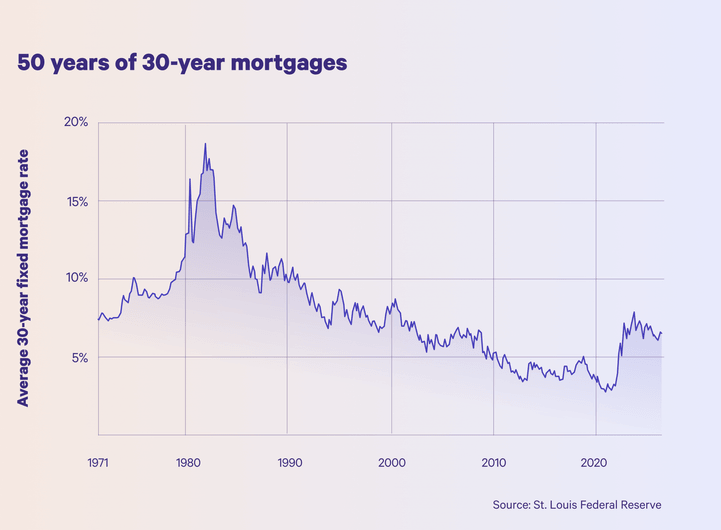
So why were mortgage rates so low for most of the last two decades? The causes were two global emergencies. First came the 2008 Global Financial Crisis. With lending freezing up and the collapse of the entire global financial system potentially at hand, the Federal Reserve rapidly cut its target “federal funds rate” (the rate at which banks borrow from each other overnight, which influences the rates consumers pay) from 5.25% in September 2007 down to a range of 0 to 0.25% in December 2008. It stayed that low for more than seven years. (Mortgage rates tend to be more closely tied to the yield of 10-year Treasuries than the short-term rate, but all three generally move together.)
Hikes followed, with the midpoint of the Fed’s target range rate peaking at 2.37% beginning in December 2018, before declining gradually from the summer of 2019 into early 2020. Then the next emergency arrived, and in response to the onset of the Covid-19 pandemic, the Fed cut its target range back down to near zero, where it stayed until March 2022. At that point, in response to elevated inflation, the Fed started raising rates rapidly, and mortgage rates followed suit. At this point both the Fed rate and the mortgage rate have come down from their peaks, but remain significantly above their troughs.
To sum up so far: mortgage rates are higher now than they were for a while, but are well within their long-term historical range. The long stretch of low rates was driven by two global crises, which we shouldn’t expect to repeat. In fact, we should probably hope they don’t. Global crises are not typically the most enjoyable circumstances—and tend to be associated with widespread job losses, which is not something that most people want to be worrying about when they are preparing to buy a home.
The current outlook is “higher for longer,” which is not entirely a bad thing
Now, what about looking forward? Unfortunately, mortgage rates could very well get higher before they get any lower. The Federal Reserve board’s “dual mandate” is to fight both inflation and unemployment—and new chair Kevin Warsh said at its June 2026 meeting that his current focus is on inflation. Specifically, he said he wants to break the inflation surge seen so far in 2026 before consumers and businesses begin to assume that prices are going to keep rising at this pace indefinitely.
At the same meeting, Warsh barely mentioned employment, apart from stating that it was in decent shape. The unemployment rate has been steady for the last 12 months, and forecasts have it remaining steady or falling very slightly through 2028. This has translated into higher-than-expected retail sales and US GDP—both of which are inflationary and more likely to lead to higher rates than lower ones. With solid employment, healthy growth, and persistent inflation, it’s unlikely that we see rate cuts anytime soon (barring any new global crises).
Interest rates aren’t the only thing that might be different if you wait
As a thought experiment, let’s imagine that mortgage rates suddenly do decrease meaningfully. One thing that would mean is that the home-seekers who had been waiting for a drop will start shopping. This increase in demand, without any corresponding increase in supply, would lead to higher home prices. It’s tough to say exactly how much prices would rise, but we can look back to the Covid crisis for guidance: From March 2020 to March 2021, with mortgage rates in the neighborhood of 3% or lower, the Federal Housing Finance Agency’s nationwide purchase price index increased by just over 14%. And a year after that, the index was almost 35% higher than it had been in March 2020.
For our example, though, we’ll assume our hypothetical reduction in the mortgage rate triggers a relatively modest 10% increase in purchase prices. Here are our other hypothetical details:
- In a scenario where rates haven’t fallen yet, a home costs $500,000, and the rate for a 30-year fixed mortgage is 6.4% (near the current rate)
- In the scenario where rates fall, the mortgage rate drops to 4.9%, a 1.5 percentage point decrease, but the price of the home increases to $550,000
In both cases we’ll assume a 20% down payment—$100,000 under current rates and $110,000 under the hypothetical lower rate.
In the first case, the principal and interest payments would come to $2,502 per month. In the second, they come to $2,335 per month—a difference of only $167. You would also have to come up with an extra $10,000 for the down payment and pay about $500 more per year in property taxes, assuming a 1% tax rate; the latter would cut your monthly savings down to about $126. Other regular costs such as homeowners and mortgage insurance, HOA dues, and escrow, all increase your monthly outlay, and all tend to increase with the home price as well–meaning that the advantage of a lower rate could be eroded even more once all of these costs are considered.
To us it is far from clear that this is a trade-off worth making, especially when you can also refinance into a lower rate if it becomes available (although remember refinancing isn’t an automatic win even if rates do decrease meaningfully – it comes with its own costs which need to be considered, and borrowers must qualify again.) Note that these monthly numbers are all proportional to the home price if you continue to assume a 20% down payment—in the case of a $1 million house, the monthly savings would be $252.
The takeaway
While it is true that mortgage rates are high relative to the last 15 years or so, they are actually fairly normal, or even below average, relative to a longer history. The low rates that some of us grew up with are unlikely to return anytime soon. Our view: If you want to buy a home, buy the one you can afford now, and refinance if rates do drop.
About the author(s)
Alex Michalka, Ph.D, has led Wealthfront’s investment research team since 2019. Prior to Wealthfront, Alex held quantitative research positions at AQR Capital Management and The Climate Corporation. Alex holds a B.A. in Applied Mathematics from the University of California, Berkeley, and a Ph.D. in Operations Research from Columbia University. View all posts by Alex Michalka, Ph.D