We recently surpassed an exciting milestone as we build toward becoming the leading financial platform helping digital natives grow wealth: Wealthfront now holds more than $100 billion in total platform assets.
This growth isn’t just a win for our company, it reflects the shared success of the more than 1.5 million clients like you who trust us with your most important financial goals, from retirement savings to down payments to emergency funds, among many others.
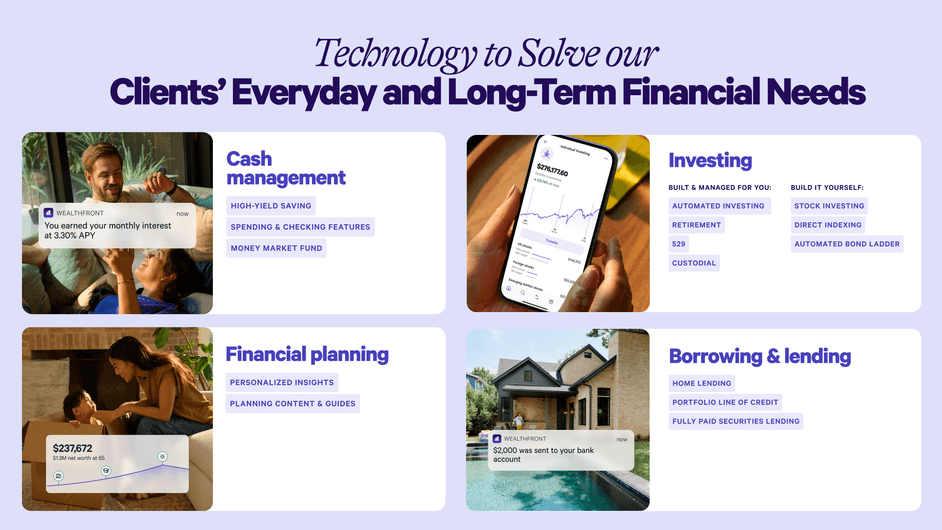
We’ve been focused on intelligent automation since we launched our flagship Automated Investing Account in 2011—long before it was a given that fully automated investing could succeed. Within a year, that product held $79.5 million. Today, our platform has grown into a suite of innovative products designed to help you save, spend, borrow, and invest for all of your goals. And digital has become the standard for how consumers manage their finances.
In this post, I’ll look back on how using technology to help improve our clients’ financial outcomes has helped us grow from less than $100 million to more than $100 billion in total assets.
Growing Alongside Digital Natives
We bet early on millennial and Gen Z investors and built Wealthfront specifically for you, even as legacy financial institutions and media narratives continued to underestimate digital natives (individuals born after 1980). We believed we could use software to change the financial industry and set young professionals up for long-term financial success.
Digital natives have undeniably faced real economic headwinds. Like me, many millennials graduated into the Great Financial Crisis, while Gen Z faced a different (but not dissimilar) period of uncertainty driven by the Covid-19 pandemic. Both age groups continue to navigate inflation, housing affordability, and a changing labor market. Despite these challenges, we’ve watched our clients remain resilient and focused on smart saving and investing strategies.
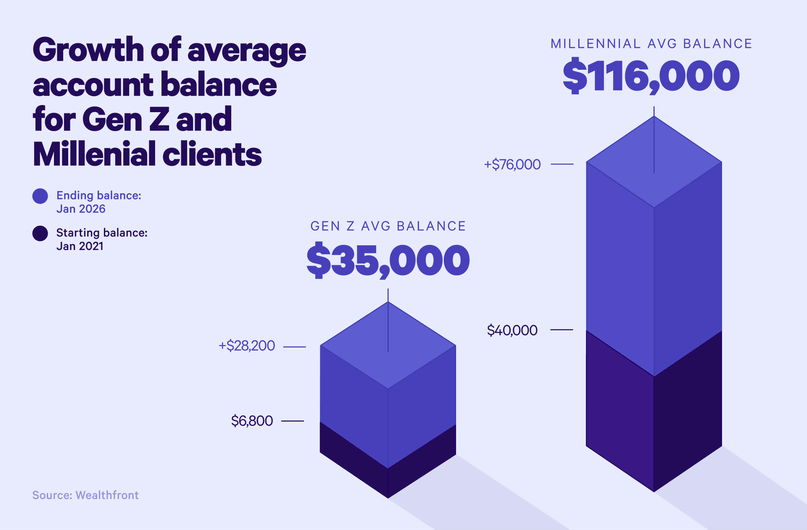
An analysis of clients who have been saving and investing with Wealthfront over the last five years (from January 1, 2021 to January 1, 2026) showed impressive growth across their accounts:
- Millennial clients collectively have nearly tripled their wealth on our platform, with their average balance at Wealthfront growing from $40,000 to $116,000 during that five year period. Across that same cohort of clients, the number of millennial clients who have over $1 million on our platform increased by over 500%.
- Gen Z clients as a group have quintupled their wealth, with their average balance at Wealthfront increasing from $6,800 to $35,000 over the same time period.
Notably, these numbers only reflect assets held in Wealthfront accounts, and don’t include assets in 401(k) plans, equity compensation, real estate holdings, or other external accounts. Today’s mainstream narratives say young investors are distracted by speculative investments, but we see a different story unfolding.
Additionally, younger generations are saving and investing at roughly double the rate of earlier generations. This means you belong to one of the wealthiest generations in history at your current age, adjusted for inflation. And we believe you’re just getting started.
Client-First Business Model
Our clients are savvy and know that if something sounds too good to be true, it likely is. From the early days, we’ve known growing your wealth and earning your trust go hand in hand. We’ve never promised outsized returns or “get-rich-quick” strategies. We set realistic expectations about what we can deliver, and work to meet and exceed your expectations over time. Unlike other financial institutions that profit from transactional activity, our revenue is tied to our clients’ assets. This aligns our business incentives with your success—we only grow when your wealth grows.
This client-first approach is woven directly into our product and investment philosophies. Everything we build is grounded in our long-term investing philosophy and designed to be intuitive, low-cost, tax-efficient, and automated. Our focus on technology means we can offer sophisticated products at a lower cost, helping you earn more on your savings, borrow at lower rates, and keep more of your returns. As of June 30, 2026, our products have:
- Saved clients an estimated $1.6 billion in advisory fees, compared to the 1% traditional advisors typically charge
- Saved clients an estimated $1.3 billion in taxes with our Automated Tax-Loss Harvesting software
- Earned clients more than $5.1 billion in interest on their cash in Cash Accounts through program banks
This creates a powerful flywheel that compounds on itself. As our automated, long-term strategies help our clients’ money grow, our business scales alongside you. We then reinvest that shared success back into the platform aimed at further improving your financial outcomes.
Evolution to a Full Wealth Management Platform
The launch of our first automated investing product in 2011 redefined the industry by making high-quality financial advice accessible through software. By 2023, twelve years after that launch, the assets held on our platform had grown to $50 billion by continuing to bring the same innovative, automated approach to direct indexing, fixed income, financial planning, borrowing, and cash management. Just three years later, our platform assets have doubled as a natural byproduct of us continuing to provide you with more ways to help grow your wealth in all macroeconomic environments.
As your financial needs change, we’ve evolved our platform to support you through new life stages. To improve access to homeownership, we launched Wealthfront Home Lending, a digital-first mortgage experience designed to reduce costs, remove unnecessary friction, and offer rates consistently below the national average. We also recently added Custodial Accounts to our family wealth management offerings, giving parents a flexible, tax-efficient way to save for their children’s futures.
The Next $100 Billion
The source of our success has always been simple: using technology to deliver more value to you. As we look ahead, that focus remains unchanged. We will continue building high-quality, innovative products that help you grow your wealth, achieve your goals, and feel more confident about your financial future.
Continuing to earn and keep your trust is our top priority. As we look ahead, we are excited to innovate with new technologies like AI to deliver more personalized, intelligent experiences that help you confidently navigate your financial journey. At the same time, we’ll also continue improving the products you already rely on—with updates to Home Lending and Stock Investing coming soon.
To the more than 1.5 million clients building your futures with us: thank you for trusting us with your hard earned savings. We have a lot more to deliver to meet your growing needs, and we’re just getting started.
Disclosure
The Cash Account is offered by Wealthfront Brokerage LLC (“Wealthfront Brokerage”), Member of FINRA/SIPC. Neither Wealthfront Brokerage nor any of its affiliates are a bank, and the Cash Account itself is not a deposit account. The Annual Percentage Yield (“APY”) on cash deposits, is representative, requires no minimums, and may change at any time. References to the APY for the Wealthfront Cash Account, including any APY increase, are to the APY paid by insured depository institutions that participate in our cash sweep program (the “Program Banks”). Wealthfront Brokerage does not pay interest. Wealthfront sweeps available cash balances to Program Banks where they earn the variable APY.
Investment management and advisory services are provided by Wealthfront Advisers LLC (“Wealthfront Advisers”), an SEC-registered investment adviser. Financial planning tools are provided by Wealthfront Software LLC (“Wealthfront Software”).
All investing involves risk, including the possible loss of money you invest, and past performance does not guarantee future performance. Securities investments are not bank deposits, are not bank guaranteed or FDIC-insured and may lose value. Please see our Full Disclosure for important details.
All mortgage products are offered by Wealthfront Home Lending, LLC NMLS 2358115 NMLS Consumer Access. Loans made or arranged pursuant to a California Finance Lenders Law License.
Home loan availability will be subject to credit approval and applicable state and federal licensing requirements. Rates vary based on credit profile, loan terms and market conditions. Not all applicants will qualify for the lowest advertised rates. This communication is for information purposes only and does not constitute a solicitation for a loan or an offer to lend or extend credit. Equal Housing Opportunity.
The information contained in this blog is provided for general informational purposes only, and should not be construed as investment or tax advice. Nothing in this communication should be construed as a solicitation, offer or recommendation to buy or sell any security or to open any account. Any links provided to other server sites are offered as a matter of convenience and are not intended to imply that Wealthfront Advisers, Wealthfront Brokerage or any affiliate endorses, sponsors, promotes and/or is affiliated with the owners of or participants in those sites, or endorses any information contained on those sites, unless expressly stated otherwise.
“Digital natives” mean individuals born after 1980 (i.e., Millennials, Gen Z, and later generations).
“Millennial clients” are defined as clients born between 1981 and 1996.
“Total Platform Assets” and “Clients” include those with assets in products from both Wealthfront Advisers and Wealthfront Brokerage. These figures are current as of August 24th, 2026, and are subject to change based on market movements, client deposits, and other factors.
Fee Savings Methodology: We first estimated the hypothetical fee a traditional advisor would charge by assuming a 1% advisory fee on assets under management (AUM). This was calculated by taking our total daily cumulative investing AUM across our managed advisory products and multiplying it by the daily effective fee (0.01 / 365) to get the hypothetical total fee amount. Next, we calculated the total fees actually charged by Wealthfront across these managed products, net of any fee waivers. Note: Standalone Direct Indexing accounts were excluded from this analysis because the appropriate comparison is typically the expense ratio of an ETF, not the advisory fee. Similarly, Stock Investing Account and our Automated Bond Ladder were also excluded as their relevant point of comparison is generally not a 1% advisory fee account. The difference between the hypothetical traditional adviser total fees and the actual Wealthfront fees charged for managed advisory products is the estimated client fee savings. This is provided for illustrative purposes only. Actual results or experiences will vary.
Estimated tax savings: We calculated the estimated tax savings based on our clients’ current self-reported income, state of residence, and tax-filing status. From that, we inferred a combined federal and state tax rate (if applicable) for each client. We then multiplied each client’s rate by their harvested losses and added those numbers up to get the $1.3B in estimated tax savings since inception (01/2012) through 06/30/2026. This calculation also assumes that there are enough capital gains to be fully offset by the harvested losses and that current tax laws and rates remain in effect. The actual tax savings realized by any individual client will vary based on their specific tax situation, investment activity, and market performance. These figures are an estimate of potential tax benefits and are not guaranteed. Investors should consult with a tax professional regarding their specific circumstances.
Interest paid out: The total interest figure represents the total amount of interest received by the Cash Account owners over the lifetime of all currently active Cash Accounts. Includes data from 02/14/2019- 06/30/2026. Interest is paid from program banks. The Cash Account, which is not a deposit account, is offered by Wealthfront Brokerage LLC (“Wealthfront Brokerage”), Member FINRA/SIPC. Wealthfront Brokerage is not a bank.
Diversification and automated investing do not guarantee profit or ensure against loss. Investor experiences can vary widely based on strategies and time horizons. Index funds and ETFs generally offer broad diversification, but may still expose investors to specific market, sector, or asset class risks. Wealthfront provides investment management services but may not achieve returns comparable to those of the general market or specific benchmarks.
Tax-Loss Harvesting benefits vary depending on the client’s entire tax and investment profile. The performance of new securities purchased may be better or worse than those sold. The strategy could introduce portfolio tracking error, meaning the portfolio’s performance might slightly diverge from its intended benchmark. There may also be unintended tax implications.
Wealthfront Advisers and its affiliates do not provide legal or tax advice and do not assume any liability for the tax consequences of any client transaction. Clients should consult with their personal tax advisors regarding the tax consequences of investing with Wealthfront Advisers and engaging in these tax strategies, based on their particular circumstances. Clients and their personal tax advisors are responsible for how the transactions conducted in an account are reported to the IRS or any other taxing authority on the investor’s personal tax returns. Wealthfront Advisers assumes no responsibility for the tax consequences to any investor of any transaction.
For the “Growth of average account balance for millennial and Gen Z clients” chart, we looked at clients with funded accounts as of January 1, 2021 and tracked their assets until January 1, 2026, filtering out those who were no longer clients.
Custodial accounts (UGMA/UTMA) come with significant limitations. Contributions to a custodial account are irrevocable gifts, meaning once assets are moved into these accounts, they belong to the beneficiary and cannot be reclaimed by the donor for any reason. You also can’t rename the beneficiary or use the assets for another person. Custodians have a fiduciary duty to use funds exclusively for the beneficiary’s benefit. Legal control of the assets automatically transfers to the beneficiary upon reaching the age of termination (typically 18 to 25, depending on the state), at which point they may use the funds for any purpose, regardless of the custodian’’s original intent. These accounts can also negatively impact financial aid eligibility because the assets are owned by the beneficiary. They are weighted more heavily than parental assets in financial aid formulas, which may significantly reduce eligibility for need-based financial aid.
From a tax perspective, Custodial accounts are not tax-deferred; they are subject to “Kiddie Tax” on unearned income above certain thresholds. For the 2026 tax year, the first $1,350 of a child’s unearned income is tax-free, the next $1,350 is taxed at the child’s marginal rate, and any amount over $2,700 is taxed at the parents’ marginal rate. Contributions must adhere to federal gift tax rules ($19,000 for individuals or $38,000 for a married couple in 2026). Any contributions over the gift tax exclusion may be subject to gift tax. Please note that these tax thresholds and gift tax limits are subject to annual adjustments by the IRS and should not be relied upon as permanent.
Product images are for illustrative purposes only and not intended to reflect any individual’s actual experience or tax loss harvested. There’s no guarantee clients will have similar experiences or results.
Wealthfront Advisers, Wealthfront Brokerage, Wealthfront Home Lending, and Wealthfront Software are wholly-owned subsidiaries of Wealthfront Corporation.
© 2026 Wealthfront Corporation. All rights reserved.
About the author(s)
David Fortunato is Wealthfront’s Chief Executive Officer. He joined Wealthfront in 2009 as the company’s inaugural CTO and was instrumental in launching the company to its first clients in 2011. Previously to his role as CEO, David was the President of Wealthfront. David holds a BS in computer science and economics from Amherst College. View all posts by David Fortunato