I am often asked “why shouldn’t I always choose the highest risk portfolio if it’s expected to generate the highest return?” That seems like a very reasonable question. In fact if everyone were rational they should choose the highest risk portfolio for exactly this reason. Unfortunately, very few people are rational.
Chasing Returns Will Hurt You
As our chief investment officer Burt Malkiel pointed out in Investors’ Most Serious Mistake, individual investors tend to chase returns. In other words they invest after markets have risen and sell when they decline. The chart below illustrates this behavior.
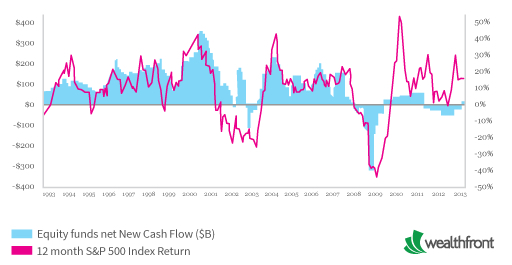
This chart plots mutual fund flows against market performance
As you can see cash flows into mutual funds when markets are up and are withdrawn when markets decline. The correlation is almost scary.
It doesn’t matter how many times most people are told not to chase returns — they just can’t help themselves. It just doesn’t feel right to invest when the market is down — but clearly that would result in better returns. Now please don’t interpret my statement as encouragement to time the market. I think it is almost impossible to time the market. Therefore the best results over the long term are likely to result from investing a constant amount every year no matter how the market has performed. We explain our logic in detail in Invest Despite Volatility.
Investors Usually Change Their Risk Profile At The Wrong Time
As we explained in The Right and Wrong Reasons to Change Your Risk Tolerance, many investors who want to heed the best practice advice of not chasing returns end up doing the opposite unconsciously by increasing their portfolios’ risk when the market has increased and decreasing it when the market has declined. You can see this behavior even among Wealthfront clients in the chart below. It plots our clients’ risk score changes relative to the performance of the S&P 500®.
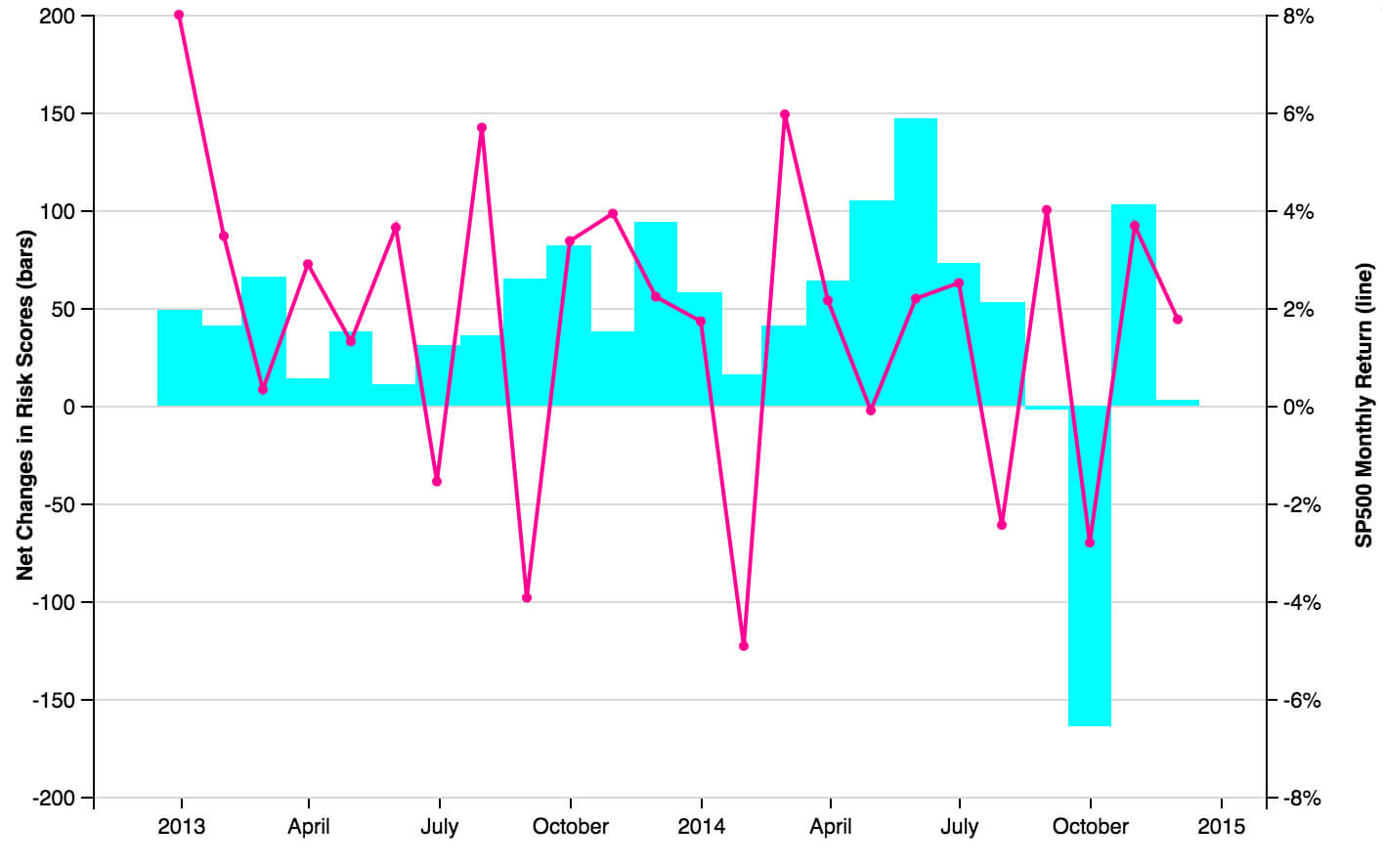
Blue bars indicate net change in risk score (left Y axis; positive numbers indicate increases in level of risk while negative indicate instances of lowered risk tolerance) versus the monthly S&P 500® return (red line; right Y axis)
You’ll notice how similar this chart looks to the earlier one — and this despite a sample of people who are bigger believers in trusting the market (you need to believe in index investing to become a Wealthfront client). Fortunately the number of Wealthfront clients who try to game their risk score is a very low percentage of our total client base.
Clearly changing risk score is no different from chasing returns. Increasing one’s portfolio risk after the market has risen is only likely to increase the amount of the loss when the markets revert to the mean. The loss will increase because a higher risk portfolio will have higher volatility, which means bigger upswings in an up market and bigger downswings in a down market. Again increasing risk in a down market is likely to improve your returns if you could time the market, but that’s impossible.
Portfolio Risk Can Be Counterintuitive
Now back to our original premise. If you were truly immune to market behavior and had a long time horizon, then it would make logical sense to choose a portfolio of the highest risk score available (risk score 10). That’s because portfolios with higher risk scores have higher expected returns, but they aren’t generally that much “riskier” over long time horizons.
I know that sounds counterintuitive, but it’s true. A higher expected return can compound so much over a long period of time that the chance of loss actually barely increases. This seemingly argues for everyone maxing out their risk.
Few People Can Resist The Power Of The Market
Before you make the plunge to a high-risk portfolio remember that very few people can resist the scary power of a down market. DALBAR, an investment research firm that has been analyzing individual investor behavior for more than 20 years has consistently found the average individual loses approximately 4% per year based on buying and selling at the wrong times.
Choosing an appropriate risk level (behavioral economists have consistently found that individuals on average overstate their tolerance for risk which we factor into our risk assessment algorithms) will protect you from yourself. A proper portfolio risk profile will be less likely to decline by an amount with which you are uncomfortable in a down market, which will make it less likely that you will sell at the wrong time.
Maxing out your portfolio risk should maximize your returns if you weren’t prone to emotion — but almost every human being is — so think twice before you start using logic as your justification.
____________________________________________________
Disclosures:
Investment management and advisory services are provided by Wealthfront Advisers LLC (“Wealthfront Advisers”), an SEC-registered investment adviser, and brokerage related products are provided by Wealthfront Brokerage LLC (“Wealthfront Brokerage”), a Member of FINRA/SIPC. Financial planning tools are provided by Wealthfront Software LLC (“Wealthfront Software”).
The information contained in this communication is provided for general informational purposes only, and should not be construed as investment or tax advice. Nothing in this communication should be construed as a solicitation, offer, or recommendation, to buy or sell any security. Any links provided to other server sites are offered as a matter of convenience and are not intended to imply that Wealthfront Advisers or its affiliates endorses, sponsors, promotes and/or is affiliated with the owners of or participants in those sites, or endorses any information contained on those sites, unless expressly stated otherwise.
Data from the DALBAR, Inc. 2014 Quantitative Analysis of Investor Behavior (QAIB) report is provided for informational purposes only. The statistics presented are based on DALBAR’s independent analysis of investor behavior. Wealthfront does not endorse, sponsor, or guarantee the accuracy of this data.
All investing involves risk, including the possible loss of money you invest, and past performance does not guarantee future performance. Please see our Full Disclosure for important details.
Wealthfront Advisers, Wealthfront Brokerage, and Wealthfront Software are wholly-owned subsidiaries of Wealthfront Corporation.
© 2026 Wealthfront Corporation. All rights reserved.
Disclosure
Nothing in this blog should be construed as tax advice, a solicitation or offer, or recommendation, to buy or sell any security. Financial advisory services are only provided to investors who become Wealthfront Inc. clients pursuant to a written agreement, which investors are urged to read carefully, that is available at www.wealthfront.com. All securities involve risk and may result in some loss. For more information please visit www.wealthfront.com or see our Full Disclosure. While the data Wealthfront uses from third parties is believed to be reliable, Wealthfront does not guarantee the accuracy of the information.
The S&P 500® (“Index”) is an index of 500 stocks seen as a leading indicator of U.S. equities and a reflection of the performance of the large cap universe, made up of companies selected by economists. The S&P 500 is a market value weighted index and one of the common benchmarks for the U.S. stock market.
The S&P 500 (“Index”) is a product of S&P Dow Jones Indices LLC and/or its affiliates and has been licensed for use by Wealthfront. Copyright © 2015 by S&P Dow Jones Indices LLC, a subsidiary of the McGraw-Hill Companies, Inc., and/or its affiliates. All rights reserved. Redistribution, reproduction and/or photocopying in whole or in part are prohibited Index Data Services Attachment without written permission of S&P Dow Jones Indices LLC. For more information on any of S&P Dow Jones Indices LLC’s indices please visit www.spdji.com. S&P® is a registered trademark of Standard & Poor’s Financial Services LLC and Dow Jones® is a registered trademark of Dow Jones Trademark Holdings LLC. Neither S&P Dow Jones Indices LLC, Dow Jones Trademark Holdings LLC, their affiliates nor their third party licensors make any representation or warranty, express or implied, as to the ability of any index to accurately represent the asset class or market sector that it purports to represent and neither S&P Dow Jones Indices LLC, Dow Jones Trademark Holdings LLC, their affiliates nor their third party licensors shall have any liability for any errors, omissions, or interruptions of any index or the data included therein.
About the author(s)
Andy Rachleff is Wealthfront's co-founder and Executive Chairman. He serves as a member of the board of trustees and chairman of the endowment investment committee for University of Pennsylvania and as a member of the faculty at Stanford Graduate School of Business, where he teaches courses on technology entrepreneurship. Prior to Wealthfront, Andy co-founded and was general partner of Benchmark Capital, where he was responsible for investing in a number of successful companies including Equinix, Juniper Networks, and Opsware. He also spent ten years as a general partner with Merrill, Pickard, Anderson & Eyre (MPAE). Andy earned his BS from University of Pennsylvania and his MBA from Stanford Graduate School of Business. View all posts by Andy Rachleff