One of the services most frequently touted by private wealth managers is their ability to provide access to outstanding alternative assets like hedge funds. Unfortunately very few private wealth managers have access to the hedge funds that are worth the fees. Of course, that won’t stop them from promising you the best and delivering poor alternatives. That’s why David Swensen, Yale’s former Chief Investment Officer and the man most identified with employing alternative assets, essentially said in the introduction to his groundbreaking book Pioneering Portfolio Management, that if you can access premier alternative assets like hedge funds, you should, but it’s highly unlikely that you can, so you shouldn’t.
Understanding Risk and Reward
As we have explained many times in this blog, returns tend to be correlated with risk. Higher returns usually can only be achieved by taking on more risk. The chart below illustrates this point well. It displays the dispersion from the average annual return for each asset class over the 15 years ended September 30, 2025.
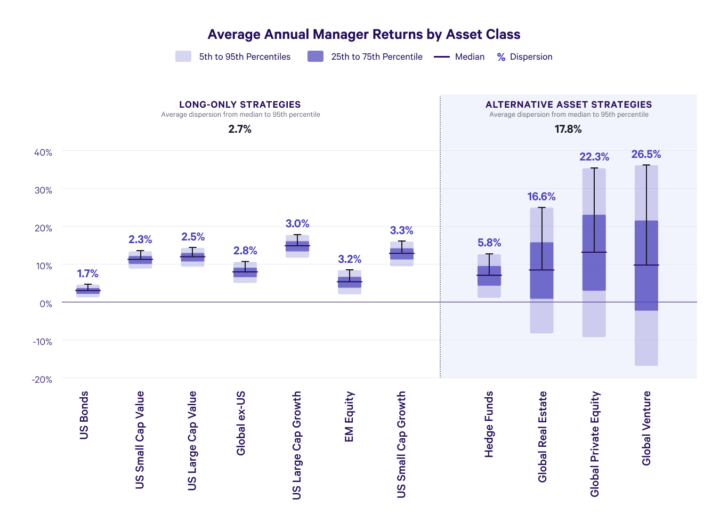
Source: Cambridge Associates and eVestments.
Note: Returns for bond and equity managers are average annual compound returns (AACRs) for the fifteen years ended 9/30/25. Returns for private investment managers are net internal rates of return calculated since inception to 9/30/25 for vintage years 2010–2024.
The asset classes have been laid out such that the least risky asset classes are on the far left and the most risky on the far right. You will notice the variance of returns within each asset class increases as the risk increases. Another way to think about this is manager selection makes very little difference at the low end of the risk scale (the left side of the graph), but makes a big difference at the high end.
Persistence among the top performers also increases as you move from left to right. A common characteristic of the best performing managers is their desire to limit the amount of money they manage. The less successful managers are willing to take as much capital as they are offered. There is a very good economic justification for this behavior. The best managers of alternative assets are paid a management fee equal to 1% to 2% of the assets they manage and 20% of the profits. If you are confident in your ability to generate outstanding returns (which are typically predicated on limiting the amount of money you manage) then you can earn far more on your percentage of profits than management fee. If you’re not confident in your ability to generate great returns then you want to maximize your capital under management to maximize your management fees. Not surprisingly, the best managers on the right side are heavily oversubscribed which allows them to be very choosy as to which investors they wish to take. Therefore access is of critical importance.
Not All Investors Are Equally Attractive
As a founding partner of one of the leading venture capital firms, Benchmark Capital, I can tell you we were very selective regarding whom we would accept as investors. University endowments are typically viewed as the ideal investor because of their sophistication and very long-term investment horizon. The worst possible clients were individual investors, typically aggregated by private wealth managers. Individuals are viewed poorly because they typically have the shortest time horizon and are inappropriately spooked by short-term negative results (i.e. they attempt to time the market).
I hope you see where I’m going. The only alternative asset managers who would accept money from private wealth management firms are typically the poor performers or the desperate. I think Groucho Marx captured the appropriate perspective for an individual investor reviewing alternative assets when he famously said “I would never join a club that would have me as a member.”
Wealthfront Has Annualized Returns that Compare Very Favorably to Hedge Funds
To illustrate how poor the typical results for hedge funds are, let’s compare the average annualized hedge fund return over the past 10 years with the average annualized Wealthfront portfolio return. To evaluate the average hedge fund, we’ll use the HFRI Fund-Weighted Composite Index. This index measures the equal-weighted, net-of-fee performance of hedge funds around the world with at least $50 million under management or $10 million under management and a track record of at least one year.
For Wealthfront we’ll use the annualized returns for our most common risk-level for our Classic Automated Investing Account (8 on a scale of 0 to 10). As you can see from the table below, the Wealthfront portfolio’s annualized return was 2.43% to 8.85% better than the average hedge fund’s annualized return depending on the time period. That’s an enormous difference in investing returns.
| Period | Wealthfront Risk Score 8.0 | HFR Fund-Weighted Composite |
|---|---|---|
| One Year | 28.50% | 19.65% |
| Five Years | 9.04% | 6.61% |
| Ten Years | 10.46% | 7.17% |
| Since Inception | 9.25% | 6.28% |
Source: Wealthfront & HFR (returns data ending on 4/30/26)
Taxes Make the Wealthfront Advantage Even Greater
The advantages of the Wealthfront portfolio become even greater when you take taxes into consideration. The Wealthfront portfolio becomes much more valuable when you add in the potential incremental benefits of tax-loss harvesting and direct indexing.
Hedge funds raise the majority of their money from tax-exempt entities like university endowments, charitable foundations and pension funds. As a result they pay far more attention to their pre-tax return than their after-tax return. Their high portfolio turnover rates lead to the recognition of significant short-term capital gains which are taxed at the highest state and federal tax rates. In contrast, Wealthfront uses index funds, which experience very low turnover, and employs dividends to rebalance its portfolios in order to minimize the number of security sales. As a result Wealthfront portfolios generate very limited short-term gains, which makes our after-tax returns even more compelling on a relative basis than what we present above.
The Perils of Fund-of Funds
To be fair, our analysis compares an average Wealthfront portfolio to an average hedge fund. As the first chart showed, the top-performing hedge funds can offer stunning returns as compared to the industry mean. However, the top-performing hedge funds are incredibly difficult to access. Many private wealth management firms address this marketing challenge by creating fund-of-funds that might get access to at most one or two top-performing hedge funds. Unfortunately the remaining 90–95% of the fund is usually filled with funds you really don’t want to own, but the only funds that are discussed in the sales process are the outstanding one or two firms. In this way many unknowing investors are hoodwinked into investing in what usually turns out to be a lousy-performing hedge fund fund-of-funds.
You Are Not An Endowment. Avoid the Fees on Mediocre Alternatives.
An investor worth several million dollars likely thinks of herself as an exceptional success, and financially, she is. However, if you don’t have at least $50 million to invest and have really good connections, then it’s highly unlikely you will have access to the premier hedge funds.
The next time you get a pitch from a financial advisor about her access to the best hedge funds, be very circumspect. It’s highly unlikely your advisor has access to anyone in the top quartile, but that won’t stop her firm from charging significant fees nonetheless. It’s common for brokerage firms to charge a 1% management fee for their hedge fund fund-of-funds (and many charge a percentage of profits as well) on top of the hefty fees the hedge funds charge—despite sub-par performance.
If maximizing your after-tax returns is what you’re after (and if it’s not, it should be) then I would avoid hedge funds (and other alternative assets) offered by private wealth managers at all costs.
Disclosure
The information contained in this blog is provided for general informational purposes only, and should not be construed as investment or tax advice. Nothing in this communication should be construed as a solicitation, offer or recommendation to buy or sell any security or to open any account. Any links provided to other server sites are offered as a matter of convenience and are not intended to imply that Wealthfront Advisers, Wealthfront Brokerage or any affiliate endorses, sponsors, promotes and/or is affiliated with the owners of or participants in those sites, or endorses any information contained on those sites, unless expressly stated otherwise.
Financial advisory services are only provided to investors who become Wealthfront Advisers LLC clients pursuant to a written agreement, which investors are urged to read carefully, that is available at www.wealthfront.com. While the data Wealthfront uses from third parties is believed to be reliable, Wealthfront does not guarantee the accuracy of the information.
Annualized returns reflect actual pre-tax performance for client accounts invested in Wealthfront’s Classic Automated Investing Account, with a composite risk score of 8 (Ranges 0.5-10). The composite includes all qualifying accounts during the covered period with at least $5,000 in assets managed under our standard methodology. Other risk scores are excluded. Accounts using enhanced features, such as Smart Beta, are also excluded as their performance may materially differ from those using our standard methodology. The performance shown is the average annual rate of return, which compounds the daily returns of client accounts from the time they were initially funded until the as of date of 04/30/26, assuming compounding through annual reinvestment of returns earned over the full period, and is calculated net of advisory fees and expenses. It represents one-, five-, and ten-year periods as well as returns since inception through the as of date provided above. This is not hypothetical or model results. Past performance does not guarantee future results.
The effectiveness of the tax-loss harvesting strategy to reduce the tax liability of the client will depend on the client’s entire tax and investment profile, including purchases and dispositions in a client’s (or client’s spouse’s) accounts outside of Wealthfront Advisers and type of investments (e.g., taxable or nontaxable) or holding period (e.g., short-term or long-term).
Tax-loss harvesting involves certain risks, including, among others, the risk that the new investment could have higher costs than the original investment and the strategy could introduce portfolio tracking error into your account. Tracking error is a measure of financial performance that determines the difference between the return fluctuations of an investment portfolio and the return fluctuations of a chosen benchmark. There may also be unintended tax implications.
Wealthfront Advisers’ investment strategies, including portfolio rebalancing and tax loss harvesting, can lead to high levels of trading. High levels of trading could result in (a) bid-ask spread expense; (b) trade executions that may occur at prices beyond the bid ask spread (if quantity demanded exceeds quantity available at the bid or ask); (c) trading that may adversely move prices, such that subsequent transactions occur at worse prices; (d) trading that may disqualify some dividends from qualified dividend treatment; (e) unfulfilled orders or portfolio drift, in the event that markets are disorderly or trading halts altogether; and (f) unforeseen trading errors. The performance of the new securities purchased through the tax-loss harvesting service may be better or worse than the performance of the securities that are sold for tax-loss harvesting purposes.
Tax loss harvesting may generate a higher number of trades due to attempts to capture losses. There is a chance that trading attributed to tax loss harvesting may create capital gains and wash sales and could be subject to higher transaction costs and market impacts. In addition, tax loss harvesting strategies may produce losses, which may not be offset by sufficient gains in the account and may be limited to a $3,000 deduction against income. The utilization of losses harvested through the strategy will depend upon the recognition of capital gains in the same or a future tax period, and in addition may be subject to limitations under applicable tax laws, e.g., if there are insufficient realized gains in the tax period, the use of harvested losses may be limited to a $3,000 deduction against income and distributions. Losses harvested through the strategy that are not utilized in the tax period when recognized (e.g., because of insufficient capital gains and/or significant capital loss carryforwards), generally may be carried forward to offset future capital gains, if any.
Wealthfront Advisers and its affiliates do not provide legal or tax advice and do not assume any liability for the tax consequences of any client transaction. Clients should consult with their personal tax advisors regarding the tax consequences of investing with Wealthfront Advisers and engaging in these tax strategies, based on their particular circumstances. Clients and their personal tax advisors are responsible for how the transactions conducted in an account are reported to the IRS or any other taxing authority on the investor’s personal tax returns. Wealthfront Advisers assumes no responsibility for the tax consequences to any investor of any transaction.
The historical practice of Wealthfront Advisers regarding its fees does not constitute a guarantee or promise concerning future fee decisions. Wealthfront Advisers reserves the right, at its sole discretion, to modify its advisory fees at any time.
Diversification and automated investing do not guarantee profit or ensure against loss. Investor experiences can vary widely based on strategies and time horizons. Index funds and ETFs generally offer broad diversification, but may still expose investors to specific market, sector, or asset class risks. Wealthfront provides investment management services but may not achieve returns comparable to those of the general market or specific benchmarks.
All investing involves risk, including the possible loss of money you invest, and past performance does not guarantee future performance. Please see our Full Disclosure for important details.
Investment management and advisory services are provided by Wealthfront Advisers LLC (“Wealthfront Advisers”), an SEC-registered investment adviser, and brokerage related products are provided by Wealthfront Brokerage LLC (“Wealthfront Brokerage”), a Member of FINRA/SIPC.
Wealthfront Advisers and Wealthfront Brokerage are wholly-owned subsidiaries of Wealthfront Corporation. © 2026 Wealthfront Corporation. All rights reserved.
About the author(s)
Andy Rachleff is Wealthfront's co-founder and Executive Chairman. He serves as a member of the board of trustees and chairman of the endowment investment committee for University of Pennsylvania and as a member of the faculty at Stanford Graduate School of Business, where he teaches courses on technology entrepreneurship. Prior to Wealthfront, Andy co-founded and was general partner of Benchmark Capital, where he was responsible for investing in a number of successful companies including Equinix, Juniper Networks, and Opsware. He also spent ten years as a general partner with Merrill, Pickard, Anderson & Eyre (MPAE). Andy earned his BS from University of Pennsylvania and his MBA from Stanford Graduate School of Business. View all posts by Andy Rachleff