

Vested Interest is a bi-weekly newsletter about what the latest developments in economics and finance might mean for your money, career, and life in general.
By submitting your email you agree to Wealthfront’s Terms of Use and will receive newsletter emails at the address provided. You may unsubscribe at any time.
Why is everything turning into a luxury product and/or subscription?
October 2, 2026
 | ||||||||
Hello and congratulations to Bear 89, a.k.a. Backpack, the winner of Katmai National Park’s Fat Bear Week. (As the offspring of a past winner—Holly, Bear 435—Backpack is technically a show-biz nepo baby.) In this issue …
| ||||||||
 Wealthfront, Getty Images, Unsplash | ||||||||
 | ||||||||
| Three numbers that explain the economic moment | ||||||||
| ||||||||
| Share this section | ||||||||
 | ||||||||
| When is AGI happening? Opinions vary by a lot. | ||||||||
| Everyone in tech loves to talk about AGI—“artificial general intelligence” or AI that is more intelligent than humans—but no one really agrees on what it means. The same goes for “the Singularity,” which is supposedly the moment when AI becomes self-controlling. And then, of course, there’s the question of whether self-controlled AI will try to destroy humanity. Below, we’ve tried to give a broad summation—based on statements made as early as 2023 and as recently as last month—of where some of the biggest voices in the discussion stand. Stay safe out there! | ||||||||
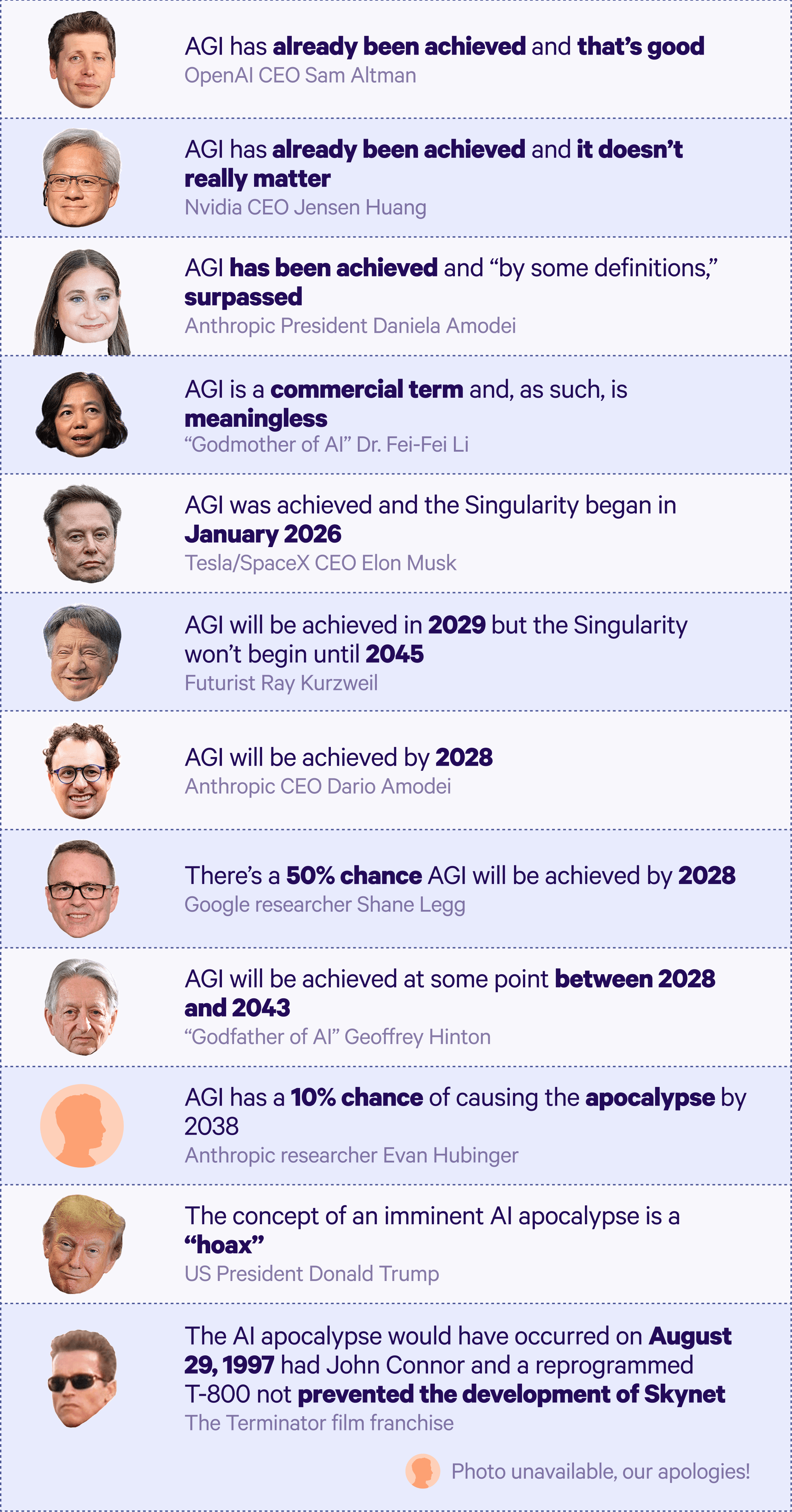 Wealthfront, Getty, Unsplash. Note: The AI landscape changes rapidly, and the views of the individuals above may evolve over time. | ||||||||
| Share this chart | ||||||||
 | ||||||||
| Reindeer gains | ||||||||
 Wealthfront, iStock Here’s a fun cocktail party fact for you, if you go to a certain kind of cocktail party: Pending the results of antitrust reviews, the world’s largest manufacturer of elevators will be based in Finland. (The next biggest—Otis, which of course we are all familiar with because of its founder’s role in inspiring Colson Whitehead’s The Intuitionist—is HQ’d in Farmington, Connecticut. Kone has facilities across the world that include an escalator factory in Illinois and a “test tower” in Texas.) | ||||||||
| Share this section | ||||||||
 | ||||||||
| Why is every hobby and social experience turning into a luxury and/or subscription? | ||||||||
 Wealthfront, Getty Images, Unsplash Is it just us, or does it seem like people are paying a lot, often on a monthly basis, for things you used to just do? What makes a paid reading retreat better than bringing a book to a park? Why join a curated group vacation instead of planning one with your friends? Are wellness treatments more effective in a subscription spa? And what about a membership restaurant—does the food taste better? What’s going on here, economically speaking? And should you join the fun? (Is it fun?) Numbers that prove we didn’t make this up According to a MasterCard survey, the average US consumer’s annual spending on subscriptions rose $417 last year to a total of $1,887. Reports by Bain & Company attest that spending on luxury experiences has grown by roughly 8% in the past two years while spending on luxury goods has actually declined. And as of last year, service-oriented businesses like fitness centers and spas occupy more square footage in the US than “goods-oriented” retailers. How things got this way That last factoid provides a clue as to what’s going on. The pandemic accelerated the rise of e-commerce and home-delivery services, bankrupting numerous physical retailers, at the same time that it created a population of remote workers who often feel like they don’t get enough human interaction. By replacing places to buy stuff with places to do stuff with other people, malls and other commercial spaces are simply responding to shifts in social conditions. Signing up for a subscription or a loyalty account, meanwhile, is an essentially frictionless experience in the era of smartphones and Stripe. A business that can get you to sign up for such an account surely will, benefitting not just from the stream of revenue you provide but from the stream of consumption data you generate. Loyalty programs also allow businesses to direct their customers toward goods and services that carry higher profit margins; airlines, these days, are often described as credit card points businesses that happen to own planes. Why do so many subscription and experience businesses cater to a high-end clientele? As this Food and Wine article about membership restaurants observes, the US’s increasing wealth and income concentration means that every year, more and more of its consumer spending is done by richer and richer people. The market is going where the money is. Does the customer get anything out of this? It wasn’t just the pandemic and remote work that made people feel like they didn’t get enough IRL contact—the decline in the number of so-called public “third spaces” is a long-term trend. The rise of paid experiences could also be related to the trend of postponing major life milestones (marriage, kids) due to the increasing cost of education, housing, and childcare. Income and time that isn’t going toward saving for a home, for example, can be put instead toward a subscription to the bowling alley. You don’t have to pay for a third space. We still have parks, libraries, and Walmart parking lots. But Robbie Kellman Baxter, author of The Membership Economy and host of the Subscription Stories podcast, observes that businesses whose “product” is a social setting aren’t just selling physical space or exclusivity. They’re also doing legwork—finding people to hang out, play a game, or scream with at a time when opportunities for organic social sorting are more rare. “Your goal might be, ‘Meet more people like me without the riffraff,’” Baxter says. “Whatever that means to you.” Daniel McCarthy, an associate professor of marketing at the University of Maryland’s Robert H. Smith School of Business, points out that professional considerations may also be involved. The decline of IRL work—not to mention the rise of AI spam job applications and the decline of social drinking with coworkers—have changed the nature of networking and hiring. (This may help explain why Silicon Valley is beginning to view smoking cigarettes as a funding round hack.) Recent research out of Australia shows that active membership in a club or association is associated with “33 percent higher odds of a jobseeker transitioning into employment,” though we realize your mileage may vary as far as how applicable you think the behavior of Australians is to anyone else. That’s the bull case, then, for paying someone to locate between five and eight other women to be nearby while you read a romantasy novel in the Cotswolds: These premium-ized experiences, like summering in Martha’s Vineyard or owning a boat, may be the difference-maker in getting the next job, promotion, or spouse. It’s up to you, of course, to decide whether that’s worth the expense. | ||||||||
| Share this story | ||||||||
 # of mentions of AI in this issue: At least 28 # of mentions of crypto in this issue: 0 Cost of Guitar Center’s Soundgarden Funko Pop set: $69.99 |
One new issue, bi-weekly
By submitting your email you agree to Wealthfront’s Terms of Use and will receive newsletter emails at the address provided. You may unsubscribe at any time.