

Vested Interest is a bi-weekly newsletter about what the latest developments in economics and finance might mean for your money, career, and life in general.
By submitting your email you agree to Wealthfront’s Terms of Use and will receive newsletter emails at the address provided. You may unsubscribe at any time.
The brave Yale professor vs. the personal-finance industrial complex
July 31, 2026
 | ||||||
 James Choi believes the average investor could stand to “amp up” their equity holdings. Read on to find out why! (Image by Wealthfront.) | ||||||
 | ||||||
| Three numbers (or abstract concepts … read on) that explain the economic moment | ||||||
| ||||||
| Share this section | ||||||
 | ||||||
| Should you do it? Should you buy an entire airplane? | ||||||
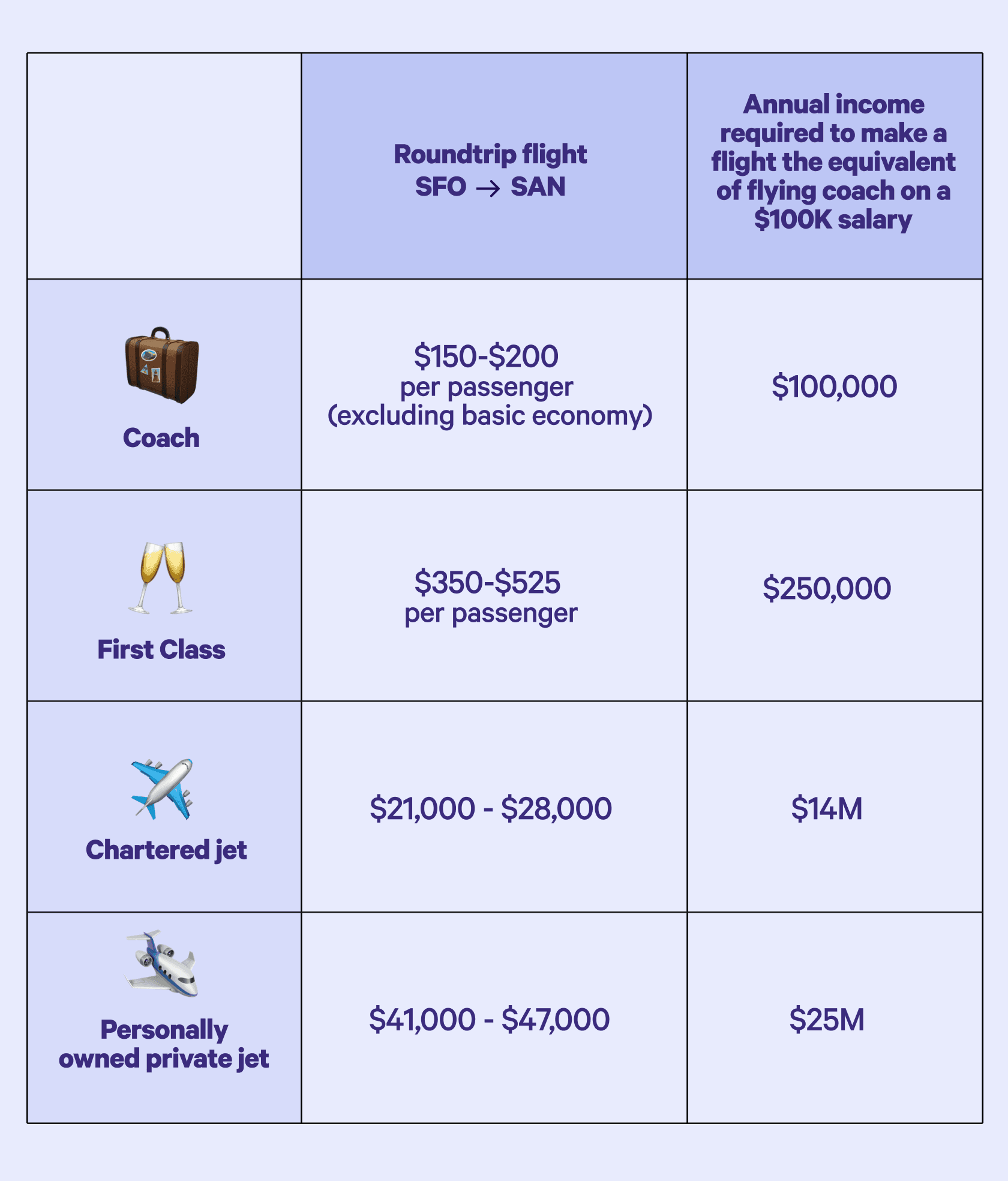 Charter estimate via evoJets for four-passenger reservation on a light jet. Personal jet estimate prorates a $2 million down payment for a light jet and annual maintenance costs ranging from $500,000-$900,000 across 200 hours of flight time, plus flight-specific costs via Aircraft Cost Calculator. Spending on private jet purchases, charters, and “fractional ownership” programs has been soaring (ha ha) due to the recent surge of IPO cash-ins, Forbes reports. If you’re wondering whether the lifestyle is right for you—Conan O’Brien is a no, FWIW, which apparently makes him more low maintenance than certain dogs—we’ve looked up how much a Thursday-to-Monday jaunt down the coast from San Francisco to San Diego would cost at a variety of luxury levels. Then we’ve roughed out how much you’d have to earn in a year for such an outlay to be a typical travel expense comparable to flying coach on an above-average professional salary ($100K, which we picked because it’s a round number). And now the choice is yours … | ||||||
| Share this chart | ||||||
 | ||||||
| Kyla Scanlon on the message that SpaceX is sending to Big AI IPO, Inc. | ||||||
In Wall Street parlance, SpaceX stock has made a “round trip” since its June debut, heading from its initial $135 price to a peak over $200 only to return back to $135 (and below). The journey reveals something about what you might call index-fund plumbing—and makes a broader point about the private valuations of buzzy Silicon Valley companies like, let’s say, just to pick two completely at random, Anthropic and OpenAI. This is the third of our three-part video series featuring author and commentator Kyla Scanlon. See here for Kyla’s Substack and here for her TikTok channel! | ||||||
| Share this section | ||||||
 | ||||||
| The questions that cutting-edge Yale finance professor James Choi wishes he had the answer to | ||||||
 Image by Wealthfront. Photo via Yale. Yale professor James Choi’s research challenging the “60/40” model and other traditional methods of dividing savings between stocks and bonds has been getting a lot of buzz lately, at least by the standards of asset-allocation discourse. He’s also written a paper critiquing bestselling personal finance books and tried to figure out how human beings make economic decisions via the unorthodox academic technique of asking them. We grilled him about whether you can really count on future working income in the AI era, what the personal finance gurus get right, and what economic mystery he’d answer if he could. You recommend that younger investors hold more stocks than most other approaches call for, even those that factor in age and risk tolerance. Yes, the greater aggressiveness is due to the incorporation of future wage income, and we provide you with a formula you can use to calculate the value of your own human capital. The idea is that future wage income is itself kind of like a bond, because it’s likely to keep coming in regularly over the course of your life, and that means you don’t need to put as much into actual bonds. But does the threat of AI layoffs, let’s say, impact your model? Human capital isn’t 100% risk-free. It’s true that human capital is risky—you don’t know exactly how your wages are going to evolve over the course of your career. However, because those risks are pretty uncorrelated with the stock market’s return, your human capital still acts like a bond. If your income is risky, it acts like a smaller bond than if it were risk-free, but overall, it’s still acting like a force that pushes your optimal financial portfolio allocation toward more risk. Really, individual wages and markets aren’t correlated? It’s true that there’s a small common component that’s shared between stock returns and wage growth. But the overwhelming majority of your personal wage growth is unrelated to the stock market’s movements, and is rather tied to factors idiosyncratic to you, like your performance review, how well your company happened to do relative to its competition, etcetera. This has been known for a long time—it was estimated in the 2005 paper that our paper is based on, and more recently Yale finance Ph.D. student Nicolas Wuthenow incorporated data through 2020 and found that the fact still holds. What was your biggest takeaway from reading all those popular books about personal finance? Popular writers have a theory of human behavior that does sometimes cause their advice to deviate from what the economists would tell you to do. And I think that the starkest example of that is with savings advice. Economists would say that you should be making your consumption—your spending levels—somewhat consistent over time. And if you’re going to have a fairly consistent spending level over your life, then you would have a relatively low savings rate in your 20s and a really high savings rate in your 40s and 50s. Personal finance gurus say no. They say you need to smooth out your savings rates and you need to be consistent about the percent of your income that you save—that saving is a discipline, it’s a muscle that you build through practice. Whether they’re right or not—I’m not aware of any scientific evidence either way—I thought it was really quite an interesting perspective and quite plausibly true. What type of personal-finance advice do you think is definitely wrong? Beware get-rich-quick schemes.1 What other asset-allocation questions do economists need to answer within the next five to 10 years? That’s an enormous question—there are so many. But I’d love to know the answer to this: Should you use cash that you have sitting around to pay down your mortgage ahead of schedule? Or should you invest those funds in the stock market? Nobody really knows the answer to that. Housing is pretty much ignored in terms of what its impact should be on your financial portfolio asset allocation. It’s very complicated to model because everything is so idiosyncratic. For example, when you’re trying to sell a home, you don’t have a million different potential buyers come and consider it, you only have a handful. That means that there’s going to be randomness in your sale price simply due to who happens to show up in that handful. The same is true when you’re trying to buy a home. What’s your personal take on thinking about homes as assets? Housing as an asset is overrated—buy a house if the type of home you want to live in is only available to buy. If you want a big house with a yard, you probably need to buy it. But if the type of home you want to live in is available in a thick rental market, you shouldn’t feel like you’re losing out financially if you choose to rent instead of buy. You just need to make sure that the money that would have gone towards building home equity in an owning situation is still being saved and invested. This interview has been edited for clarity. 1Here Choi named a particular personal finance author whose name we are withholding out of professional discretion. | ||||||
| Share this story | ||||||
 # of mentions of AI in this issue: 3 # of mentions of crypto in this issue: 0 # of mentions of dog airplanes in this issue: 1 |
One new issue, bi-weekly
By submitting your email you agree to Wealthfront’s Terms of Use and will receive newsletter emails at the address provided. You may unsubscribe at any time.