

Vested Interest is a bi-weekly newsletter about what the latest developments in economics and finance might mean for your money, career, and life in general.
By submitting your email you agree to Wealthfront’s Terms of Use and will receive newsletter emails at the address provided. You may unsubscribe at any time.
Wealth taxes are having a resurgence
October 16, 2026
 | ||||||||
Good morning, afternoon, or evening! Two Americans, who don’t even write a biweekly markets newsletter by the way, were awarded the Nobel Prize in Economics on Monday for their work on defusing boom-and-bust cycles. Congrats to all the nominees. In this issue…
| ||||||||
 Keep reading for a primer on why wealth taxes are back in fashion. Photo illustration by Wealthfront; source images from Alamy and iStock. | ||||||||
 | ||||||||
| Three numbers that explain the economic moment | ||||||||
| ||||||||
| Share this section | ||||||||
 | ||||||||
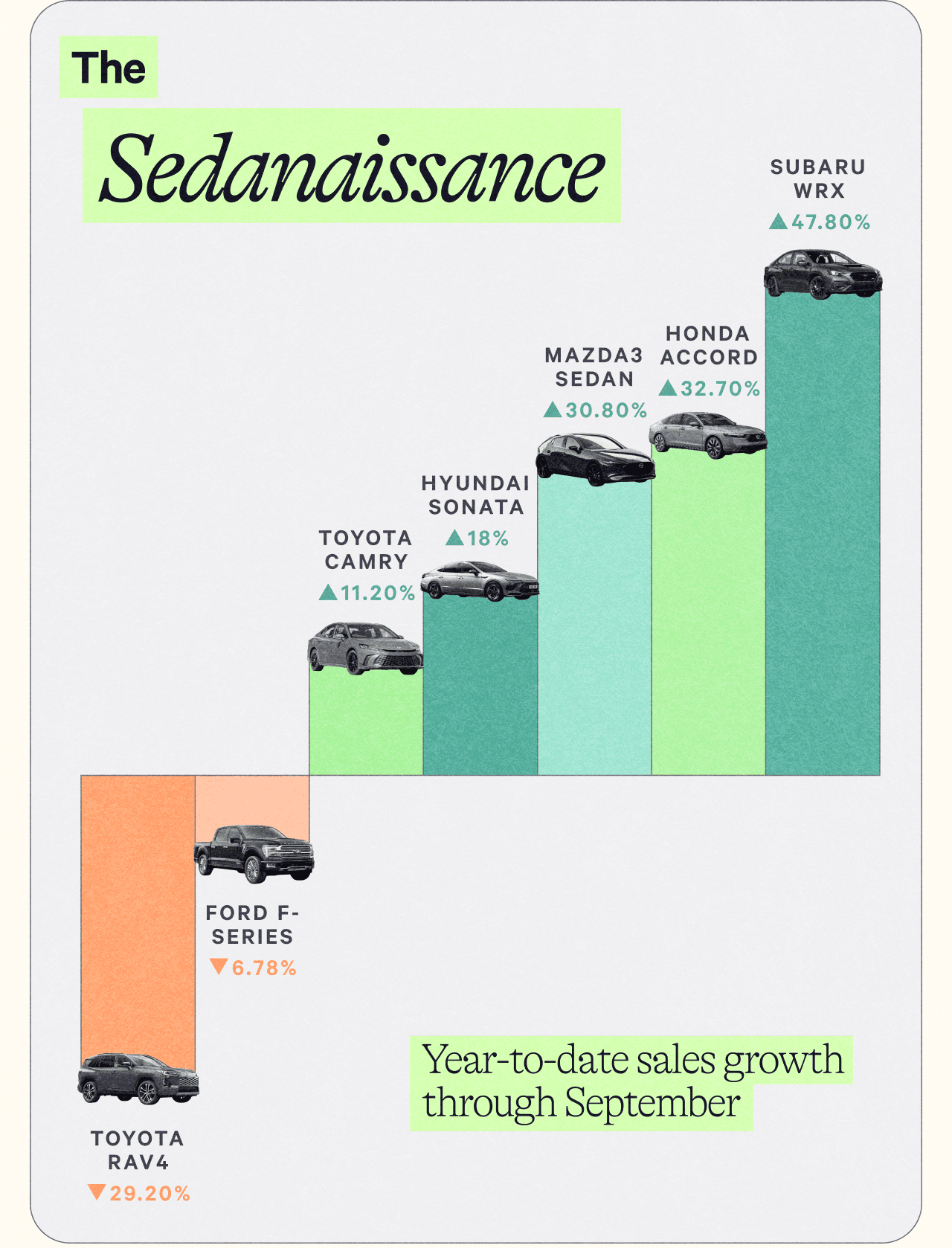 Sales data is released monthly by automakers. Photo illustration by Wealthfront; source images from Toyota, Ford, Hyundai, Mazda, Honda, and Subaru. With gas prices up more than 40% from last year, sales of large trucks and SUVs are slowing while sedans like the Honda Accord and Mazda3 are the hottest vehicles on the market. Smaller pickups like the Ford Maverick hybrid are doing well too, and the much-awaited Slate Auto EV truck may begin shipping in December. Ford, as it happens, scrapped production of sedans altogether in 2019—but is now thinking about bringing them back. | ||||||||
| Share this chart | ||||||||
 | ||||||||
| Why wealth taxes are having a moment | ||||||||
 Photo illustration by Wealthfront; source images from Alamy, Getty Images, and iStock Until recently, taxes aimed only at the super-rich were a dying breed. As recently as 1990, at least half of the countries in the OECD had some form of “wealth tax” on the books. (An income tax takes a percentage of your annual income; a wealth tax takes a percentage of your entire net worth.) But most were eventually abandoned amid a political backlash against high taxes and a number of painful episodes in which national heroes like Gerard Depardieu and the founder of IKEA fled their home countries to save money. (Gen Z readers: Gerard Depardieu is a French actor.) In the modern era, the US hasn’t had wealth taxes at all. In November, though, California voters will decide whether to impose a one-time net worth tax of 5% on the state’s billionaires. It could pave the way for other measures in the US and beyond: Similar levies are up for discussion in France, Germany, and Sweden, while New York City is trying to tax pied-à-terre homes and the state of Washington is holding a referendum on adding a 10% surcharge to the income tax bill of anyone who makes more than a million dollars a year. What happened to bring this idea back into circulation—and does it matter to you if you aren’t a billionaire (yet)? Let’s discuss. Where the urge to tax is coming from Part of what’s happening is cyclical: At just about the exact point that wealth taxes had fully gone out of fashion, economists and activists began noticing that inequality was swelling around the world. The trend hasn’t let up during the AI-fueled post-pandemic recovery, whose benefits have gone disproportionately to those fortunate enough to already be invested in the US stock market. It’s perhaps not surprising, then, that the marquee fight over wealth taxation would take place in California, whose Proposition 40 would apply to individuals who were worth a billion dollars or more as of January 2026. The state’s 200 or so billionaires include a handful of tech founders and CEOs that currently rank among the wealthiest humans to ever live. (If you were wondering: Prince Harry and Meghan Markle’s fortune is estimated at $60 million, which means they wouldn’t have had to pay even if they hadn’t decided to move back to the UK.) Governments could also really stand to find new sources of revenue right now: Global sovereign debt has hit $348 trillion (!) as countries like the US and UK run huge deficits. That’s one of the reasons interest rates have been going up: National treasuries are borrowing a lot of money, and investors are asking for higher and higher rates of return in order to give it to them. (There’s disagreement, to be clear, about whether raising taxes only on the very rich will do much to address any of this.) Likewise putting upward pressure on rates: The AI buildout, which runs on borrowed money too. The view from Mountain View Billionaires tend to say they don’t believe that society’s problems will be most effectively addressed by taking money from billionaires—and they have the means to act on that belief! Google co-founder Sergey Brin has put more than $138 million into political action committees campaigning against the tax, while figures like Jeff Bezos, Sam Altman, and Elon Musk have suggested alternative means of leveling out wealth. (Of note: Bezos and Musk live in Miami and Texas, respectively, and Mark Zuckerberg recently bought a large property in Florida as well.) On the other hand there’s Anthropic’s Dario Amodei, who wrote an essay in January arguing for further taxation of tech wealth, and Nvidia’s Jensen Huang, who amiably told Bloomberg he’d be “perfectly fine” paying the 5% tax if it happens. Why does this matter? If the wealthy can avoid paying a given tax by challenging it in court or simply moving, the government trying to impose the tax might end up making less tax revenue than it would have in the first place. (FWIW, California’s nonpartisan budget analysis office projects that the tax would raise “tens of billions” of dollars and cost “less than $1 billion a year” in lost income tax revenue resulting from emigration. A study by proponents of the wealth tax estimated that California billionaires currently pay about $3 billion a year total in income taxes.) It’s also easier for tax authorities to gauge the value of publicly traded assets than ones that are privately held. Joel Slemrod, a professor emeritus of economics at the University of Michigan, explains that this could mean a wealth tax would trigger a movement out of the stock market and into private assets—thus reducing the value of the indexes that many Americans’ savings are built on. The non-billionaire’s decision The architects of California’s tax say their proposal avoids this problem by being a one-off: A backwards-looking tax that’s only imposed once, they say, won’t change incentives going forward. “If everyone really believed it was going to be a one-time thing, you can imagine some of these asset holders would just suck it up and say, ‘I don’t like this, but it’s not worth changing everything I do,’” Slemrod says. But history, he says, also shows that taxes enacted as one-offs can stick around. In essence, California’s situation is a game of chicken: Voters need to decide whether they think billionaires are really going to bail on the state if the measure passes, and billionaires need to decide if they think voters are really going to stop at one instance of wealth taxation. It’s a face-off for our times, and not likely to be the last of its kind. | ||||||||
| Share this story | ||||||||
 What did you think about this issue? Too long? Too short? Not enough discussion of the most inept alleged attempt at corporate espionage in history? And what else should we be writing about? Let us know via askwealthfront@wealthfront.com. |
One new issue, bi-weekly
By submitting your email you agree to Wealthfront’s Terms of Use and will receive newsletter emails at the address provided. You may unsubscribe at any time.